


Planning Approval Like a Good First Date

The refusal.
No one wants it. No one plans for it. Yet it happens all the time.
Imagine going on a first date and, within the first five minutes, you are asking about children, marriage, where you will live together, retirement plans, and how you both feel about settling down by the coast.
There is a good chance the other person is checking where the exits are. They might be climbing out of the bathroom window before the starters arrive.
Bear with me, because this is exactly how many people approach a planning application.
They have a small cottage, a plot of land, or a dream for one amazing house. They get excited. They rush. They pull together a few drawings, submit a full application, and hope the local planning authority will fall in love with the idea straight away.
Then the decision arrives.
Refused.

That refusal can feel personal. It can feel unfair. It can feel like the system is against you.
In many cases, though, the proposal was not ready for the conversation it was trying to have.
Planning Approval Like a Good First Date is really about pacing, preparation, listening, and knowing when to ask the big questions.
Why rushed planning applications get refused
A planning application is not just a form, a location plan, and some drawings.
It is a case. It is a story. It is an argument for why a proposal belongs in that place, at that scale, in that form, with that material palette, and with that impact on neighbours, landscape, heritage, access, ecology, drainage, and character.
When that story is missing, the application becomes easy to refuse.
A rushed submission often has the same warning signs:
Weak drawings with limited detail
Little or no explanation of the design approach
No pre-application discussion
No clear planning strategy
No consultant input where it is needed
No proper response to local policy
No design statement or weak supporting statement
No evidence that constraints have been understood
That might sound harsh, but it is common.
Someone buys a plot or inherits a building. They can already picture the finished home. They know the view from the kitchen. They know where the morning light will come in. They know how the family will use the garden. The end goal is clear in their mind.
The problem is that the planning officer cannot see what is in your head.
They see the documents in front of them.
If those documents do not explain the proposal clearly, the officer has to assess what is submitted. If the application gives them reasons to doubt the design, the principle, the access, the impact, or the policy position, the safest answer is often no.
The first date mistake in planning
On a first date, you do not normally open with every major life decision. You start with a conversation.
You listen. You ask questions. You see what matters to the other person. You notice the pauses, the reactions, the subjects that spark interest, and the subjects that need care.
Planning works in a similar way.
If you go straight in with a full application for your dream house, without testing the principle or understanding the concerns, you are asking for commitment before trust has been built.
The local planning authority may have questions such as:
Is the principle of development acceptable here?
Does the proposal fit local and national planning policy?
Is the scale right for the site?
Will the design protect the character of the area?
Are there heritage concerns?
Could neighbours be affected by overlooking, massing, or loss of light?
Is access safe?
Are there ecological constraints?
How will drainage be handled?
Is the proposal too urban, too large, too visible, or too unexplained?
If those questions are not answered properly, the application can quickly feel like too much, too soon.
That is when refusal becomes likely.
Why an appeal with the same information often fails
After a refusal, many people feel the next logical step is an appeal.
Sometimes an appeal is the right route. But appealing with the same weak information can simply lead to the same result, only later and with more frustration.
An appeal is not a magic reset button. The inspector will still look at the proposal, the policy position, the evidence, the drawings, the officer’s report, and the reasons for refusal.
If the original application lacked detail, failed to explain the design, ignored key constraints, or did not build a strong case, an appeal may not fix that.
It can feel like sending the same bad first message again and expecting a different reply.
If the story was not clear enough the first time, repeating it louder rarely makes it more convincing.
A refusal gives useful information. It tells you where the weaknesses are. But to change the outcome, the approach often needs to change too.
That may mean revisiting the brief, adjusting the design, commissioning the right reports, speaking to the local authority, and rebuilding the case from the ground up.

A better way to approach the application
Now imagine a different approach.
You do not start by asking for the full commitment. You start by understanding the site.
You look at the existing building or land properly. You study the planning history. You read the local policies. You check the constraints. You ask what the authority is likely to support and where the risks sit.
Then you build a strategy.
That strategy might include:
Early design discussions
Pre-application advice
A clear client brief
A defined end goal
Measured surveys and proper site analysis
Strong concept drawings
Input from planning, heritage, ecology, arboriculture, highways, drainage, or landscape consultants where needed
A design and access statement that explains the thinking
A complete planning package that answers likely concerns before they become objections
This is where experience matters.
A good planning team does not just draw the dream house. They help shape the route to approval.
They know when to push, when to pause, when to gather more evidence, and when the design needs to change before submission.
They also know that planning officers are not just judging whether a house looks nice. They are assessing it against policy, context, impact, precedent, and public interest.
A beautiful design can fail if the planning case is weak.
A challenging site can succeed if the case is carefully built.
Pre-application advice is the conversation before the commitment
Pre-application advice is one of the most useful parts of the process when used properly.
It is not always perfect. It does not guarantee approval. It can take time, and the response may raise difficult points.
But that is the value of it.
A pre-app can reveal how the local authority sees the site before you spend more time and money on a full application. It can highlight concerns around scale, design, access, landscape, heritage, or policy. It can also confirm where there may be support.
This is the planning equivalent of having a proper conversation before asking for a second date.
You are not walking in cold. You are listening. You are testing the mood. You are seeing what needs to be adjusted.
That does not mean giving up on ambition. It means presenting ambition in a way that makes sense.
For example, if you want to replace a small cottage with a larger home, the planning authority may want to understand:
Why replacement is justified
How the new building relates to the original footprint
Whether the size increase is reasonable
How the design responds to local character
Whether the landscape can absorb the proposal
What materials are proposed and why
Whether the building improves the site or causes harm
If your application answers those questions clearly, the conversation changes.
The planning package needs to tell the whole story
A strong planning package is not about making the submission heavier for the sake of it.
It is about making it clearer.
The aim is to remove doubt where possible. The officer should be able to understand:
What exists now
What is proposed
Why the proposal has been designed that way
How the site constraints have shaped the scheme
How the design responds to policy
What impact the proposal will have
Why approval should be granted
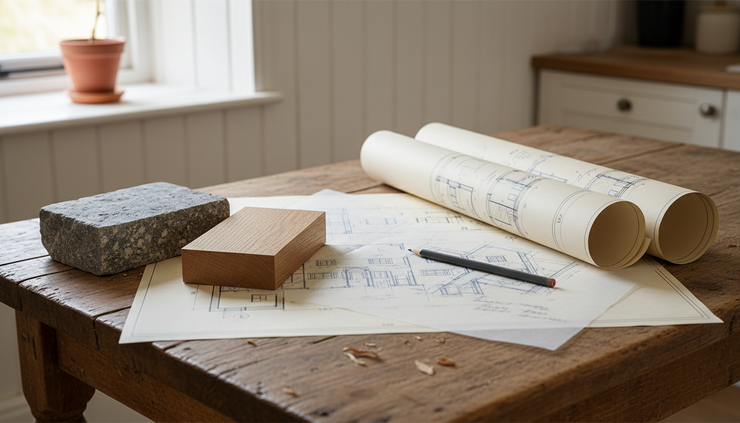
The drawings need to be accurate and detailed. The supporting documents need to speak to each other. The design statement should not be a generic brochure. It should explain the specific site, the specific proposal, and the specific planning logic.
This is where many applications fall down.
They show the end result, but not the journey.
In planning, the journey matters.
A local authority wants to see that the proposal has evolved from an understanding of place, not just from a wish list. It wants to know that the building belongs there.
Why the slower route can be the faster route
A careful planning strategy can take longer at the beginning.
It may take months to gather the right information, prepare the design, speak to the authority, revise the scheme, and submit a complete package.
For more complex sites, the wider process can take 1 to 2 years.
That can sound painful when all you want is approval.
But compare it with the alternative.
You submit too early. You wait. You get refused. You revise in a hurry. You appeal. You wait again. The appeal is dismissed. You are now a year or more down the line, with less money, less energy, and still no permission.
A 12-month journey ending in refusal is not quicker than a longer, better managed journey that gives the proposal a real chance.
Planning is not only about speed. It is about sequence.
Do the right things in the right order and the whole process becomes more controlled.
The good first date approach
Think about the date again.
A good first date takes preparation.
You choose somewhere suitable. You think about timing. You have options for a drink, a meal, or an activity. You listen. You do not force every conversation at once. You work out whether there is a connection and whether a second date makes sense.
You do not need to pretend to be someone else. You just need to show up well.
A good planning application works in the same way.
You prepare the site. You prepare the story. You prepare the drawings. You prepare the evidence. You listen to advice. You understand the risks. You give the local authority a clear reason to support the proposal.
That does not mean every application will be easy. Some sites are difficult. Some policies are restrictive. Some designs need several rounds of change. Some projects require patience.
But patience is not failure.
A refusal after a rushed submission can set the whole project back. A careful strategy can build confidence step by step.
What our approach looks like
Our approach starts before the full application.
We want to understand the site, the ambition, and the end goal. We want to know what you are trying to achieve, but also what the planning system is likely to accept.
From there, we build the route.
That may include early sketches, planning research, consultant advice, pre-application engagement, design development, and a detailed planning package.
The goal is simple: give the proposal the best possible chance from the start.
We cannot guide you on the date. You are on your own there.
But we can guide your next planning application.

Come and talk to us at Grand Designs Live
If you are thinking about a plot, a cottage, a replacement dwelling, or a future self-build project, come and see us at Grand Designs Live at the NEC from 2nd to 4th October.
Bring the idea. Bring the questions. Bring the site if you have one.
We can talk through how to approach it properly, what to avoid, and why the right strategy at the start can make all the difference later.
Free tickets are available via our Instagram bio.
Before you ask the planning system for the big commitment, make sure the first conversation is a good one.


Comments